




Key Takeaways
- Pablo’s final assessment was that the latest AT10 lineup delivers “an evolution, not a revolution” while offering a feel very similar to the 2026 rackets.
- For defensive situations, Pablo selected Edu Alonso’s EA10 ahead of the other models because “what you do with your arm is pretty much what the ball does.”
- To limit impact through the frame, Nox developed the new VCS handle system, which laboratory testing found “reduces vibrations by around 60%.”
A closer look at the new Genius and Ventus ranges
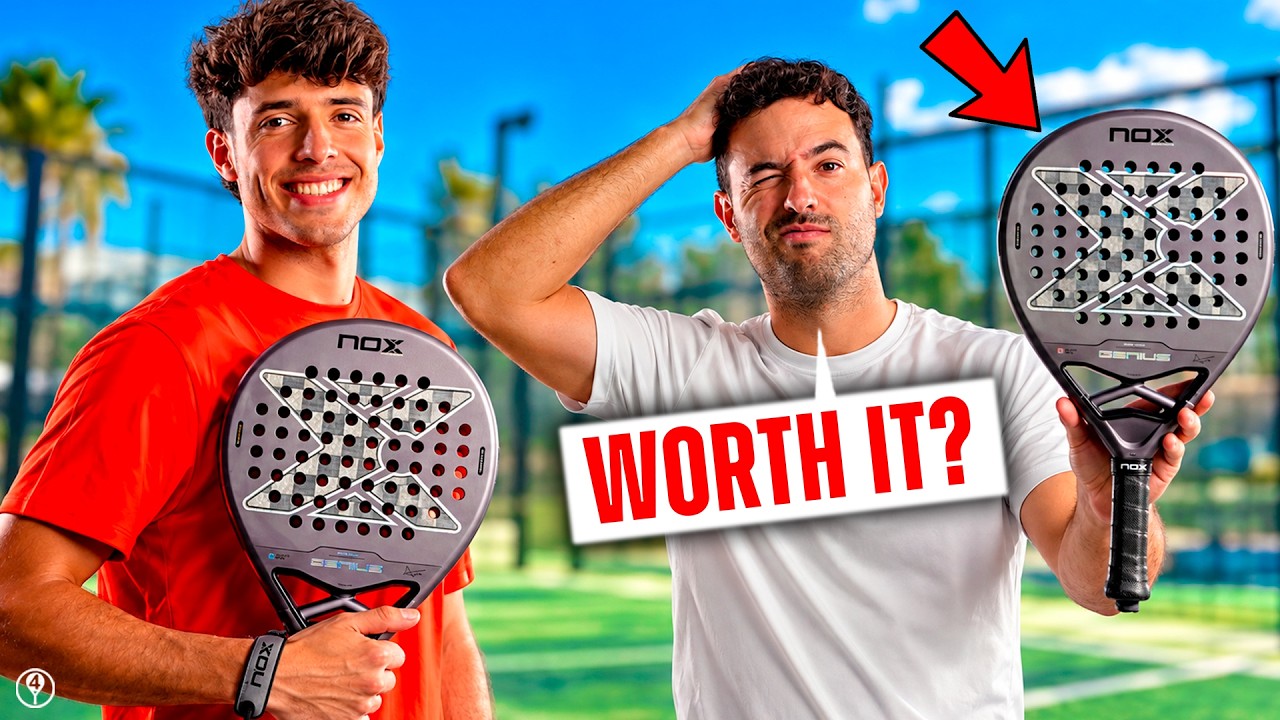
The Nox 2027 collection has undergone a comprehensive on-court review by the4Set equipment analyst Pablo, who compared the leading rackets associated with Agustin Tapia, Edu Alonso, and Aimar Goñi. Nox has organized the collection into two model families, offering two padel shapes and three carbon configurations. Tapia’s signature rackets form the Genius range: the hybrid versions have an approximate balance of 25 centimeters, while the diamond-shaped attack models sit at around 27 centimeters. The Ventus family, meanwhile, includes Alonso’s hybrid EA10 and Goñi’s attack-oriented AG10.
The adjustable weight and balance mechanism at the top of the frame remains available throughout the range, giving players additional setup options. Attack versions also use a handle extended by 1 centimeter to create more leverage. Emphasizing the importance of the balance point during play, Pablo observed that “those 2 cm of difference in balance are very noticeable on court and they definitely affect performance.”
Structural changes and the available carbon configurations
Nox selected three main carbon constructions for the seven rackets in the test: 18K Alum, 12K Alum Extreme, and 12K Extreme. Factory engineers say the aluminized finish helps maintain consistent performance when temperatures fluctuate. Extreme carbon, by contrast, reduces the interwoven fibers by approximately 50 percent, resulting in a thinner and stiffer sensation. MLD Black EVA multilayer core foam is used across the collection except in the AT10 Light, which is about 10 grams lighter and contains the softer HR3 White foam.
The VCS handle system is among the range’s principal technical changes. Built with an elastomer, it produced Nox laboratory results indicating that it “reduces vibrations by around 60%.” Larger air channels in the bridge are intended to improve aerodynamics and counterbalance the extra handle weight, while the racket sides receive additional structural reinforcement. Pre-orders for the four main AT10 rackets are priced at €390; the AT10 Light, EA10, and AG10 cost €350. The first deliveries are scheduled for October.
Power-test results and performance standings
Pablo tested outright power in Madrid at 20 degrees Celsius, using new balls and calculating the average distance from five smashes with every racket under controlled conditions. His longest average came with the 12K Hybrid, narrowly ahead of the AG10 and 12K Attack. In terms of pure overhead speed, the softer 18K rackets ranked further down the order.
| Rank | Defense | Volleys | Bandejas and Viboras |
|---|---|---|---|
| 1 | EA10 | 12K Hybrid | AG10 |
| 2 | 12K Hybrid | EA10 | 12K Attack |
| 3 | 18K Hybrid | AG10 | EA10 |
Alonso’s EA10 led Pablo’s rankings for defense from the baseline, with his reasoning being that “what you do with your arm is pretty much what the ball does.” Its controlled response carried the 12K Hybrid into second place. Third went to Tapia’s signature 18K Hybrid, as “one of the easiest to feel comfortable with right away.”
At the net, the 12K Hybrid topped the attacking-volley assessment because of its clean response and accuracy when directing the ball. Pablo offered this view of the 18K: “if you prioritize comfort and want the racket to give you a little more help, you might actually prefer the 18K, but for my game, I take in the 12K.”
For transition overheads, including bandejas and viboras, the firmer AG10 proved to be the leading option. As Pablo explained, “when you make contact high on the racket, you really feel it respond.”
How the 2027 rackets compare with the 2026 generation
In comparing the latest changes with the previous generation, Pablo considered whether recreational players would notice a major advance over the 2026 edition of Tapia’s racket. His direct verdict on the feel was: “if you covered the designs and handed me one rocket after the other, I will have a very hard time telling them apart because the feeling is almost identical.”
Pablo’s overall verdict on the range was that “the 2027 NOX rackets are an evolution, not a revolution.” He said players whose 2026 rackets remain in good condition should not feel compelled to replace them, although he confirmed that the 2027 generation has successfully “keeps all the qualities that made this racket so popular in the first place.”